
The IAB SEA+India AI Council brings together technology leaders from across the digital marketing ecosystem to address the region’s most critical AI implementation challenges and opportunities. Council Members lead presentations and discussions on priority topics, with the IAB SEA+India team developing these into features to share the Council’s insights and guidance with the wider industry.
Presenters: Haroon Qureshi, WPP Media; Matthew Drury, Meta; Shubham Dubey, The Coca-Cola Company
Discussion Participants: Aileen Chua, RTB House; Andrew Ridsdale-Smith, Kantar; Divya Acharya, WPP Media; Emir Caglayan, WPP Media; Ibrahim Merican, Magnite; Lee Smith, Omnicom Media Group; Marc Holloway, Smartly; Miranda Dimopoulos, IAB SEA+India; Nhi Tran, WPP Media Vietnam; Priya Bhatia, OpenX; Rohiet Ghildyaal, Eyeota, a Dun & Bradstreet Company
TL;DR: Southeast Asia and India are redefining how marketing content gets created by moving faster than other regions to adopt generative AI tools and proving co-creation between humans and machines delivers measurable business results. Campaigns now launch in 48 hours instead of 60 days, brand compliance checks happen in seconds rather than weeks, AI business messaging empowers businesses to be more effective, and interactive experiences generate over a million engagements.
The Region That Jumped In Fast
Across Southeast Asia and India, teams are co-creating content with AI. Brands compress go-to-market timelines by over 90%, automate compliance processes consuming weeks into seconds, and generate millions of consumer engagements through interactive experiences.
The content landscape has evolved again
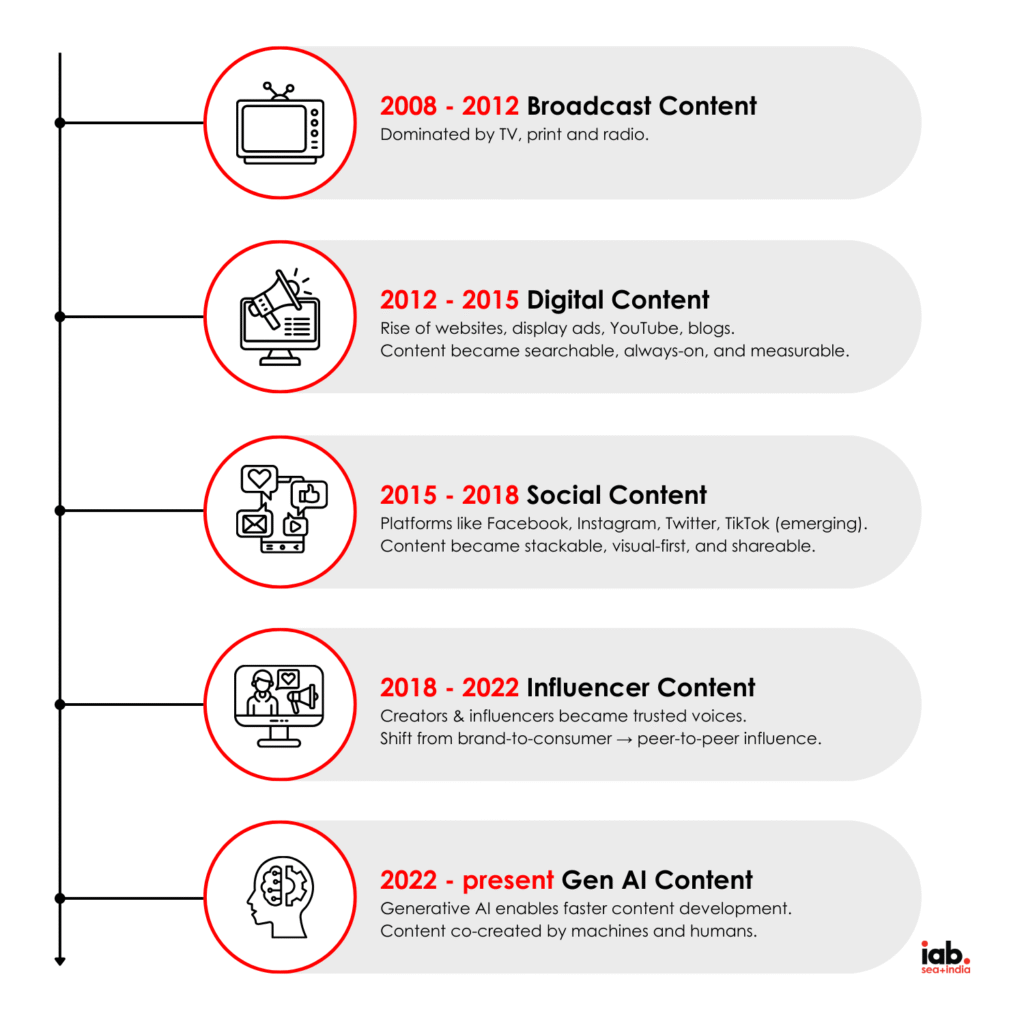

“Southeast Asia and India didn’t adopt AI slowly, we jumped in fast,” explains Haroon Qureshi, Retail Brand Experience & Partnerships, Mindshare at WPP Media. “Before 2021, only a few tech companies and startups were trying it. But once tools like ChatGPT, Google Gemini and TikTok Symphony Creator Studio became available, creators, small businesses and even brands started using them quickly.”

The velocity requirements driving this adoption keeps accelerating. “Something we often overlook is the importance of the invention of the newsfeed. Feed-based social platforms like Facebook, Instagram, and TikTok increased the speed of consumption and that continues today,” observes Matthew Drury, Agency Development Lead at Meta. “AI is something that satisfies the hunger for that speed of consumption.” Meta’s creative best practice decks now recommend brand presence in the first three seconds instead of fifteen, as consumers expect content to be refreshed constantly.
AI has added new layers to creative production, from suitability design to brand compliance. These steps now sit across clients, agencies and partners, reinforcing the value of a connected operating model.
The Client-Agency-Partner Model in AI Creative Production
Creative production has always relied on brands, agencies, and partners combining their strengths. Client teams understand their products, consumers and commercial goals, agencies translate insight into campaigns and execution, and partners provide the technology and environments to help campaigns come to life.
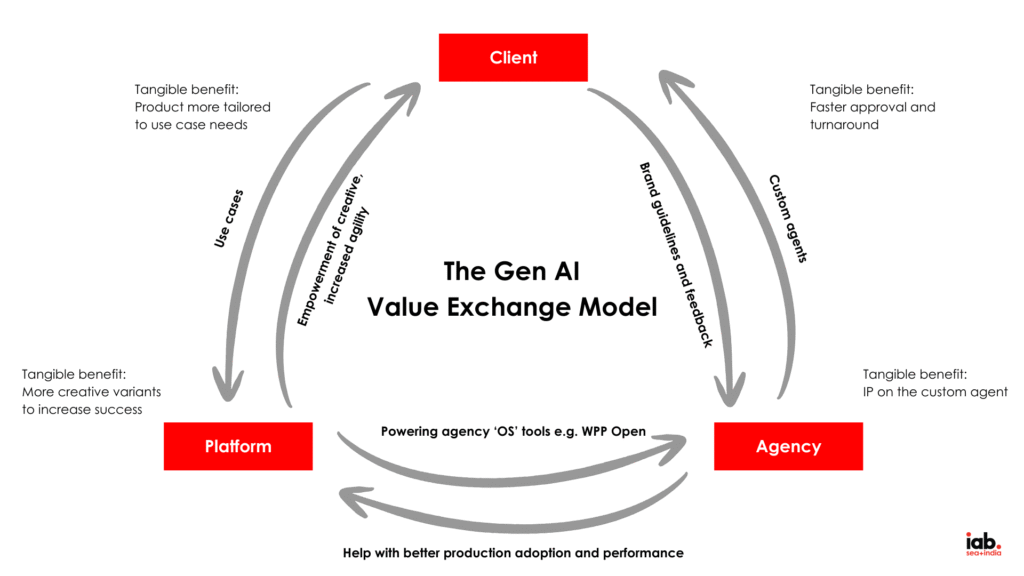
What is changing is the type of creative campaigns now flowing through this long-established model; AI-assisted production, automated asset checks, conversational experiences, and AI-powered co-creation require closer coordination between strategic direction, creative development, and campaign execution.
1. Client-Partner Collaboration
Enterprise example: The Coca-Cola Company and Adobe Firefly
AI-enabled compliance gives brands faster creative workflows
For The Coca-Cola Company, campaign development required compliance checks across nine operating units, covering colours, fonts, logo placement, image treatments and tone. The volume of assets moving through this workflow meant reviews often ran for weeks.

Shubham Dubey, Senior Manager, Marketing Technologies at The Coca-Cola Company describes the challenge and ambition: “Imagine 30 to 60 days of timeline in terms of briefing of content, content generation, this is the activation. All this process has been squeezed and the ultimate aim is can I go ahead and generate and activate content in the next 24 to 48 hours.”
Partnering with Adobe Firefly, The Coca-Cola Company introduced Style IDs, an AI-enabled validator confirming whether an asset meets brand guidelines. Shubham explains: “For every campaign planned for this year 2025, we are going to create a style ID. Your creator, your marketeer can upload the image and the style ID will immediately scan the image and tell you yes, this is a 100% brand compliant creative.”
The adoption of Style IDs removed a dependency in the review cycle, giving teams across the nine operating units a more predictable path through validation. Fizzion transforms brand guidelines into intelligent assets, enabling creative teams to produce content up to 10 times faster while maintaining quality, integrity and design control. A shared interface helps co-creation between The Coca-Company, Adobe and also extends to agencies, reducing the back-and-forth often required to confirm brand elements and strengthening alignment across the ecosystem.
SME example: White Coat Manila and Meta
AI business messaging strengthens customer responsiveness for SMEs
In this region, business messaging is deeply entrenched in how consumers interact with companies. Small and medium businesses rely heavily on messaging platforms for customer service, with WhatsApp, Messenger, and similar channels serving as primary communication tools for product enquiries, order tracking, and purchase decisions.
White Coat Manila, a medical scrubs seller in the Philippines, implemented Meta’s Business AI on Messenger to generate conversational responses helping customers shop. Business AI Messenger handles common questions about product availability, sizing, and store locations, providing 24/7 support. During a six-week trial, White Coat Manila achieved a 20% decrease in customer service costs and a 5% increase in customer conversations, with more consumers visiting stores.
“The solution here was more based on empowering the sales staff rather than replacing them, it allowed them to focus more on selling and less on the more onerous tasks that could be automated,” notes Matthew. The AI handles basic enquiries while human agents remain available for complex situations. Regional implementation requires attention to language nuances. “It needed some tweaking because it was in Tagalog,” Matthew shares. “You just take extra care that it doesn’t hallucinate if it’s in another language that isn’t English.”
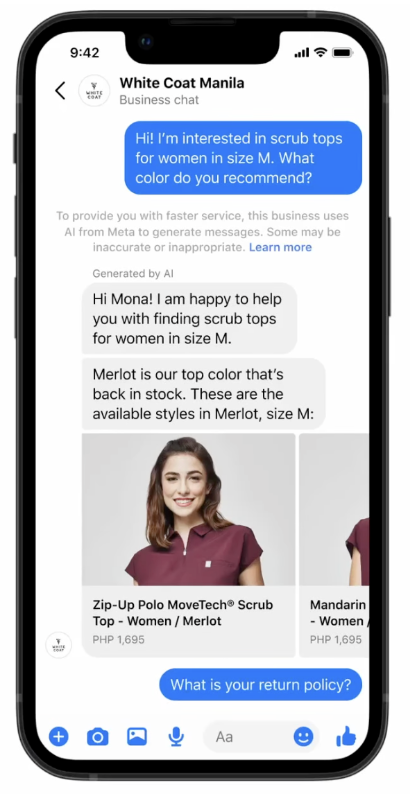
For SMEs, having AI tools handle routine questions means customers receive faster answers, and human agents stay involved when decisions are more complex and shoppers need advice or reassurance.
Superapp example: Grab Vietnam, Smartly and Google
AI-powered creative levels the competitive playing field
The festive season brings a surge in demand for food delivery. As one of Southeast Asia’s largest delivery platforms, Grab Vietnam saw over 13,000 merchants heading into this peak period with no dish photography on their app listings. Many of these were independent merchants – the late-night mì trộn shop or the bánh mì stand with loyal regulars – lacked the visual content that drives clicks.
Consumers eat with their eyes first and listings without photos receive fewer clicks, and fewer clicks means fewer orders during the year’s highest-volume trading period.
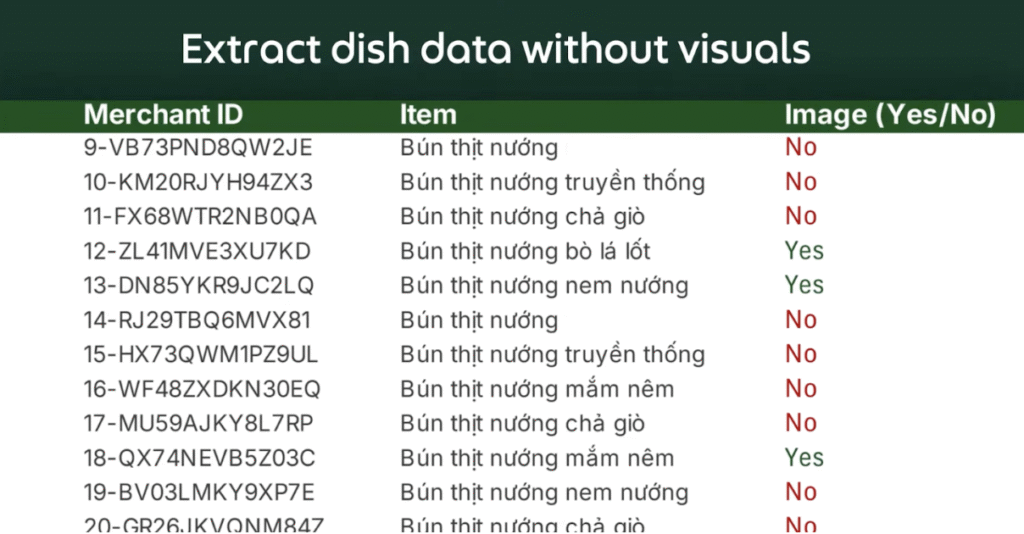
Grab Vietnam developed Yum AI, a creative tool trained on food imagery. Yum AI identified merchant menu items without visuals, extracted ingredients and dish names, then selected appropriate stock images; top-down angles, close-ups, centre framing, correct bowl sizes for display formats within the app.
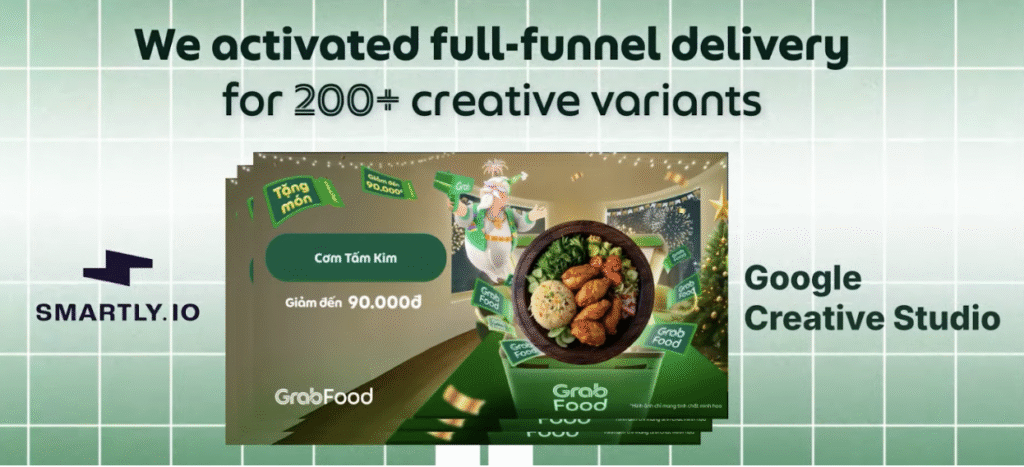
Yum AI generated visuals for over 50,000 menu items across 13,000 merchants, giving small vendors studio-quality imagery for their profiles without photography costs or production timelines. To drive app traffic during peak season, Grab Vietnam partnered with Smartly and Google Creative Studio to automate advertising delivery across 200 personalised creative variants. By combining location signals, behavioural timing, and contextual triggers to match messaging to user moments, whether someone was watching food content or browsing late at night.
The campaign delivered 10% order growth and 14% traffic increase and merchant satisfaction reached its highest score of the year. Brand health improved by three points, with 3 million paid app sessions and a 30% reduction in cost per app open.
Yum AI gave 13,000 small businesses the similar creative capabilities as large brands with production budgets, levelling the competitive playing field on a delivery platform serving millions of consumers.
2. Client–Agency-Partner Collaboration
Closeup, WPP Media and Uberduck
AI creates personalised songs to help express what people can’t always put into words
WPP Media identified an insight for their client Unilever’s Closeup brand; young couples often struggle to express their feelings, and many turn to music to communicate with someone they like.
This insight informed the Love Tunes campaign, an interactive experience turning short text prompts into personalised rap songs. Haroon explains the idea: “When you can’t find the right words to express your love, use music as a new language to express your feelings.”
Love Tunes launched in the Philippines and then expanded to India, generating 1.2 million engagements and more than 500 song downloads. The build took six to eight months as Closeup’s first generative AI project in APAC, involving legal clearances, partner vetting, LLM partner approval and music licensing. Haroon notes the lack of precedence at the outset: “There was no playbook, no internal benchmarks, but the whole process basically helped us build a very strong operational model or a process from ground zero.”

WPP Media redesigned the prompt flow after recognising the risks of open text inputs to enable consumer participation while protecting brand suitability. Haroon shares, “You can’t have an open prompt and give it in the hands of consumers. So we have to generate a custom prompt module for people to build this whole experience.”
Humans Setting the Direction of AI-Enabled Creative
Creative production across Southeast Asia and India is part of a campaign ecosystem constantly being refined and redefined by AI adoption making brand compliance checks, customer conversations, performance adaptations and co-creation experiences easier to execute.

AI extends what can be created, but the inspiration and direction stays with humans. Divya Acharya, VP of Solutions Design & Marketing Science, APMEA at WPP Media captured this balance simply: “A human needs to think of the idea. AI can then augment its creation and scale its impact.”

The skills and knowledge needed to carry those ideas forward is evolving and talent profiles are also widening. “Hiring creatives in the past was quite straightforward. It was an art director or a writer,” explains Lee Smith, Managing Director, TRKKN at Omnicom Media Group. “And now it’s really about people who think about where the data is coming from, how they can connect different platforms, how they can get feedback from the general insights in the marketplace where trends are happening.”
AI-enabled creative requires expertise across multiple skills, Lee notes: “I think now the expectation is that people come to the table, they need to be full circle on understanding. Obviously we want creative minded people, but we want people who understand the dynamics of how an amazing tool can help them. So people who think as much about the output as they do about where the inputs are coming from.” This means knowing not just what makes compelling content, but how campaign content will be deployed, automated, optimised and sustained.

Cultural interpretation also stays with humans. Andrew Ridsdale-Smith, Head, APAC Analytics Practice at Kantar explained the risks of direct transfers across markets, saying, “When you take something from English and drop it into Southeast Asia, the nuance is lost.” Identity, tone and references carry different meanings across different countries, so creative intent stays with teams who can interpret how language and context live within each market.
Haroon offers a final reflection: “I’ve been in the industry for 17 years and I’ve not seen this pace before.” This momentum will continue and each next stage in the content landscape will come from pairing the latest technology with teams who understand insights, audiences and campaign strategy. AI will always evolve, but the direction of creative production will remain in human hands.
want to read more insights from the iab sea+india ai council?
The IAB SEA+India AI Council brings together expert insights and real use cases of AI across the region, helping the industry navigate opportunities in Southeast Asia and India.