
The IAB SEA+India AI Council brings together leaders from across the digital marketing ecosystem to address the region’s most critical AI implementation challenges and opportunities. Members lead presentations and discussions on priority topics, with the IAB SEA+India team developing these into features to share the Council’s insights and guidance with the wider industry.
Presenters: Aileen Chua, RTB House; Joseph Lee, PubMatic; Ryan Pham, Google
Discussion Participants: Bharat Khatri, Omnicom Media Group; Divya Acharya, WPP Media; Emir Caglayan, WPP Media; Lee Smith, Omnicom Media Group; Marc Holloway, Smartly; Matthew Drury, Meta; Miranda Dimopoulos, IAB SEA+India; Rohiet Ghildyaal, Dun & Bradstreet; Shubham Dubey, The Coca-Cola Company
TL;DR: Marketing teams across Southeast Asia and India now know campaign outcomes before launch. AI processes real-time behavioural signals to identify which users will convert, when they’ll engage, and what message will resonate. Teams predict success during activation rather than waiting for post-campaign analysis, with humans providing strategic direction while AI multiplies their capabilities.
When the Numbers Line Up
Southeast Asia and India’s marketers now predict campaign success before launch. AI processes thousands of behavioural signals during activation, revealing which users will convert, when they’ll engage, and which messages resonate while campaigns run.

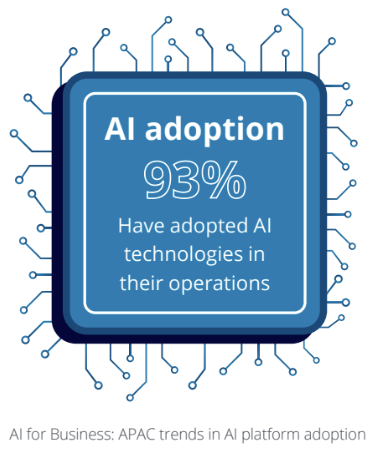
“We have been seeing a shift in expectations or roles of CMOs beyond just the top level brand building, but more directly on results driven like sales or profitability,” explains Aileen Chua, Managing Director, Southeast Asia, RTB House. This focus on business impact has accelerated AI adoption across the region: Vietnam at 93%, Indonesia at 79%, Malaysia at 78%, and Thailand at 77%.
The alignment happens at three levels. Customer business objectives like growing revenue and market share cascade down to marketing objectives around acquisition and engagement, which then translate into media objectives focused on conversions and reach. AI connects these layers by processing real-time signals: product views, cart additions, browsing sequences, time between visits, turning raw first-party data into patterns to predict outcomes.
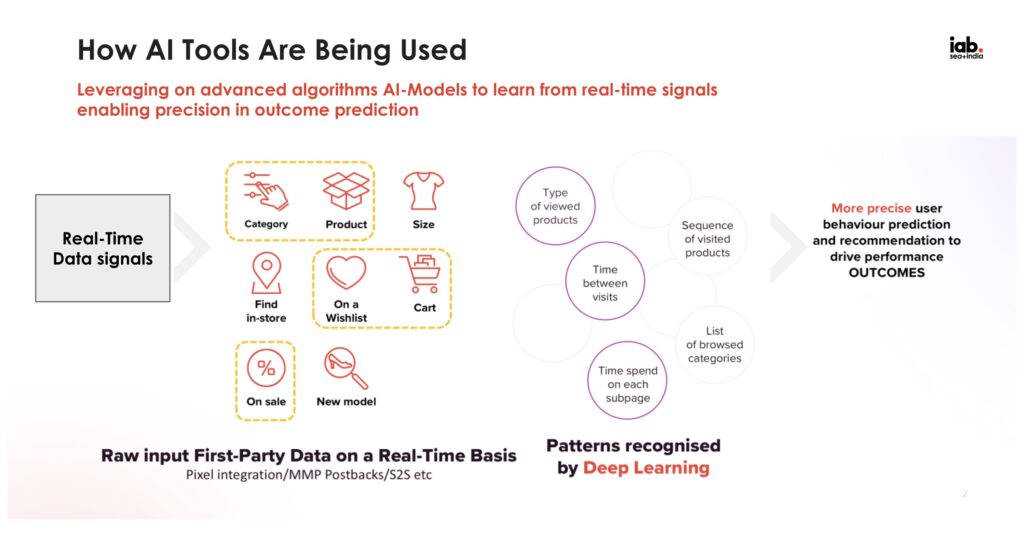

As Ryan Pham, Industry Manager, Google notes: “With the right signals, AI finds the right outcome you’re looking for.” These signals flow continuously through pixel integrations and platform postbacks, with deep learning recognising patterns that indicate purchase intent, creating what Aileen describes as “more precise user behaviour prediction and recommendation to drive performance outcomes.”
For marketers facing pressure to deliver business results, this capability offers a different approach to activation. Rather than launching campaigns and waiting, teams can now see performance patterns as they emerge and adjust based on actual behaviour. The key is using these real-time signals to predict and achieve specific business objectives during activation.
Reading the Signs: Three Strategies for Campaign Success
Marketers are already using these real-time signals to achieve outcomes once reserved for post-campaign analysis. The following three strategies show how AI reads behavioural patterns during activation to deliver results.
Strategy 1: Finding Tomorrow’s Customers Today
Predictive activation succeeds when AI’s deep learning capabilities process thousands of behavioural signals simultaneously – cart additions, browsing sequences, time between visits – to identify purchase intent before users themselves recognise it. This pattern recognition at scale uncovers high-value audiences in unexpected segments.
Singapore furniture brand Castlery needed to expand beyond their existing customer base in a competitive luxury market. Deploying RTB House’s deep learning AI to analyse behavioural patterns, they focused on users who had engaged but never converted. The AI identified “lapsed shoppers who interacted but never bought before and only added to cart.” These overlooked segments delivered 7x conversion uplift through precision timing, turning dormant data into active growth.
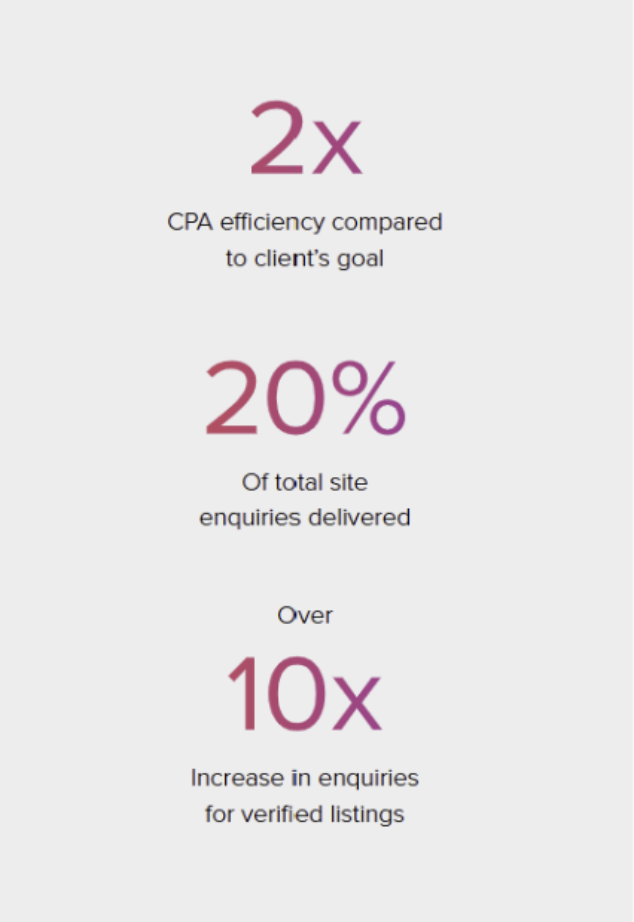
99.co’s real estate portal needed to qualify property enquiries more efficiently. Using RTB House’s AI technology to distinguish serious buyers from casual browsers, they achieved 2x CPA efficiency whilst generating 20% of total site enquiries. AI discovered that users who viewed verified listings multiple times and checked neighbourhood amenities showed genuine purchase intent. By creating personalised experiences based on these behavioural patterns, 99.co converted browsers into buyers at half the cost.
“All these signals and events allow the AI model to understand the entire user journey,” Aileen explains. “From products they have viewed, the category, whether they have done a search, or whether they have added to their wishlist, or even started an order or purchase.” The key is recognising patterns across these micro-behaviours to identify users ready to convert..
For marketers, this means untapped audiences already exist in your data. The users you’ve written off as browsers, the visitors who abandoned carts months ago, the segments that don’t fit your ideal customer profile: these represent your next growth opportunity. AI identifies intent patterns to create new possibilities, you’re finding customers who were always there, waiting for the right moment and message.
Strategy 2: Multiple Signals, Single Fortune
When campaigns span multiple platforms and touchpoints, AI processes complexity at scale. Rather than optimising each channel separately, AI understands how behaviours across touchpoints predict overall value.
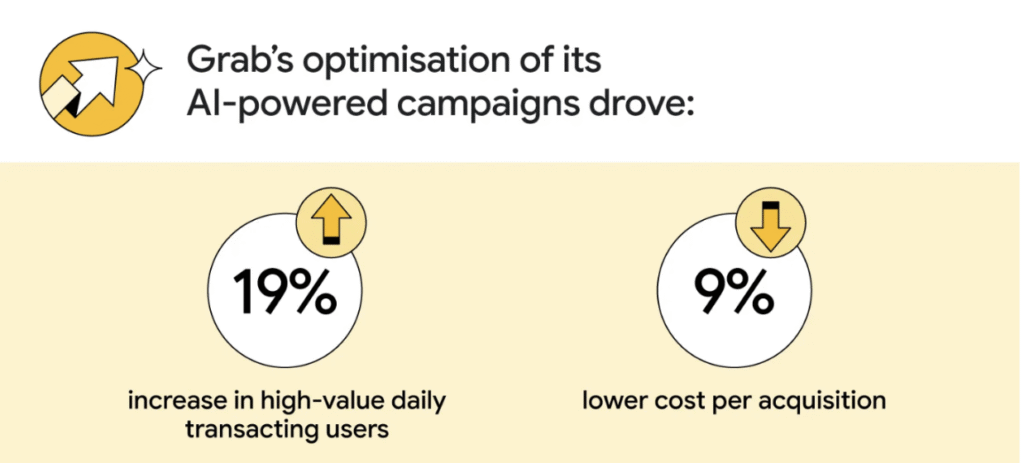
Grab’s superapp implementation shows this in practice. Ryan Pham, Google, explains the challenge: “How can you basically turn complex user behaviour into multi-events fuels the entire AI-powered campaigns?” Their solution: GA4 Audience Triggers processing signals across ride-hailing, food delivery, and payments to identify high-value users before they become high-value. This approach achieved 19% increase in daily transacting users while reducing acquisition costs by 9%. For marketers, this shows how connecting behavioural signals across platforms changes unit economics, not just targeting efficiency.
“With the right signals, AI finds the right outcome you’re looking for,” Ryan notes. “The AI definitely gives better results if you give it the right outcomes you want, the right data sets, the right signals, the right creatives.” Rather than treating channels separately, AI learns how behaviours combine to create value across the ecosystem.

This multi-platform capability extends to team operations. Marc Holloway, Head of Customer Success APAC, Smartly describes their custom GPT implementation: “The Customer Success team at Smartly uses an internal custom ‘Case Study Bot’ GPT to surface recent success stories from this region. For example, if they are about to talk to a travel customer, they can simply ask for success stories from any vertical and any market and immediately use them to support our customers to get more from Smartly.” Teams access proven patterns across markets instantly, applying successful approaches without recreating work.
Strategy 3: Every Second Tells a Story
Beyond multi-platform signals, AI optimises campaigns continuously during flight, adjusting creative, targeting and bidding based on performance data in milliseconds.
“In a fraction of a second, an AI algorithm can analyse a user’s demographics, browsing history, and real-time behaviour to determine the most relevant ads,” explains Joseph Lee, Director, Advertiser Solutions, SEA + Korea + Hong Kong + Taiwa, PubMatic. “This is why most of us have asked before, how is the algorithm reading my mind?”
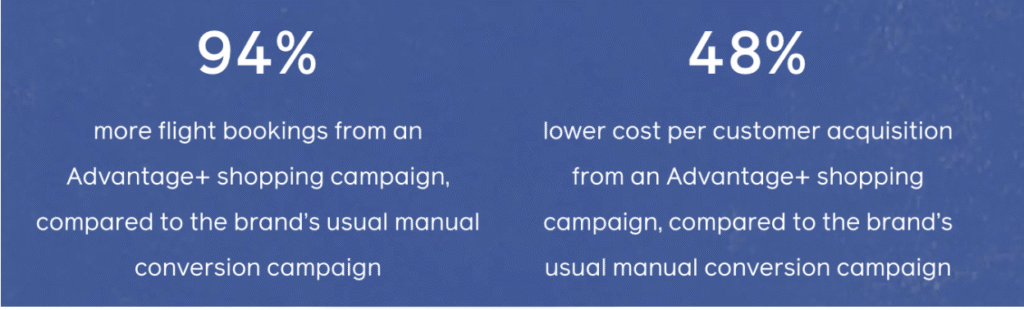
Cebu Pacific’s partnership with Meta‘s Advantage+ shopping campaigns shows this automated optimisation in practice. Letting AI handle audience selection, creative placement and budget allocation for flight bookings, they achieved 94% more bookings and 2.4x higher return on ad spend at 52% lower cost per purchase. The AI continuously adjusted targeting and bidding throughout the campaign, finding the right passengers at the right moments.

For marketers, this continuous optimisation means campaigns improve automatically throughout their run. Rather than waiting days or weeks to gather enough data for manual adjustments, AI refines targeting and creative every hour based on real-time performance. Underperforming segments are reduced immediately while successful approaches expand, turning every campaign into a learning system that gets smarter with each impression.
As Joseph describes, AI uses “historical campaigns, user engagements and market trends to identify audiences most likely to convert.” Every impression teaches the system something new, building intelligence that compounds returns over time. Joseph notes. “As a result, it can also dramatically increase conversion rates and outcomes for the brand.”
Fortune Favours the Predictive
Southeast Asia and India’s marketers now know campaign outcomes before launch. AI processes behavioural signals in real-time – from cart additions to browsing patterns to platform interactions – identifying which users will convert, when they’ll engage, and what message will resonate.
The three strategies delivering these outcomes each address different opportunities. Finding tomorrow’s customers today means discovering high-value audiences in unexpected places, like RTB House identifying lapsed shoppers who deliver conversion uplift. Connecting cross-platform signals reveals customer value patterns, as Grab discovered by linking behaviours across ride-hailing, food delivery and payments. Real-time personalisation ensures every impression improves, with PubMatic creating individualised experiences in milliseconds.
These capabilities change how teams operate. “Advertisers can focus on high-impact strategic initiatives while AI handles the routine and everyday tasks.,” explains Ryan. Teams now focus on strategy and creative thinking, with AI multiplying their capabilities.
“Our industry relies heavily on trust from clients, customers; basically everyone in the ecosystem,” notes Joseph. “We should be looking to do away with the black box nature of AI decisions and look towards a more transparent model.” As AI handles more campaign elements, maintaining visibility into decision-making is business critical.

Lee Smith, Managing Director, TRKKN, Omnicom Media Group, sees ongoing progress: “Different clients are looking for us to solve challenges. We’re building what we think we should be on our side. I think in two years’ time, we’ll be looking back to all the different things we’ve been working on. Some things we will have gotten right, and some things will just keep growing.”
What once took weeks of post-campaign analysis now happens during activation. AI processes the signals, identifies the patterns, and predicts the outcomes. Human strategists provide the vision and creative thinking that no algorithm can replicate.
For Southeast Asia and India’s marketers, the future has become remarkably predictable.
want to read more insights from the iab sea+india ai council?
The IAB SEA+India AI Council brings together expert insights and real use cases of AI across the region, helping the industry navigate opportunities in Southeast Asia and India.